
DeKalb Parole vs Probation
Parole and probation are both supervision, but they start from different places. Parole is tied to a state-prison sentence and is handled through the Alabama Bureau of Pardons and Paroles after ADOC custody. Probation is usually ordered by a court and may be part of a county sentence, split sentence, plea, or suspended sentence. A released DeKalb County jail detainee is not automatically on either one.
| Status | Who creates it | DeKalb verification path |
|---|---|---|
| Parole | ABPP after a state-prison case | ADOC parole status, ABPP hearings/results, ABPP records. |
| Mandatory release supervision | ADOC and ABPP under Alabama law | ADOC release fields and ABPP supervision information. |
| Probation | District or Circuit Court order | DeKalb Circuit Clerk and court case records. |
| Discharge | End of sentence or supervision | ADOC, ABPP, court, or records request depending on source. |
- Parole
- Supervised release from a state-prison sentence before final discharge.
- Probation
- Court supervision that may let a person serve part or all of a sentence outside jail or prison.
- Absconder
- A person accused of failing to report or leaving supervision contact.
- Discharge
- The point when custody or supervision ends for the sentence.
Verify DeKalb Post-Release Supervision
The right search starts with the release source. A person released by the DeKalb County Detention Center on bond may have a court case but no ABPP parole record. A person transferred to ADOC and later released on parole or mandatory release supervision may have ADOC fields, ABPP hearing results, and a local supervision contact. That distinction keeps a jail release from being mistaken for a prison discharge.
- Check the jail release record first when the person recently left the DeKalb County Detention Center.
- Search ADOC by AIS number or name when the case became a state-prison sentence.
- Review ADOC fields such as parole status, parole consideration date, minimum release date, jail credit, and custody.
- Use ABPP scheduled parole hearings and current-year results for hearing activity.
- For probation terms, sentence orders, or disposition, check the DeKalb Circuit Clerk and Alacourt record path.
- When public pages do not answer the question, use ABPP public-records requests or the court records request path.
ABPP's results page also has an important reset-date note. A reset date is the first month and year a person may be considered for a future docket, not a new hearing date. That point matters when a DeKalb family member sees a denial and tries to estimate the next release step.
DeKalb Supervision Office Detail
DeKalb has a named local ABPP supervision resource. The Fort Payne Day Reporting Center Lite is listed by ABPP as serving DeKalb County. It is not a jail and it does not confirm a county jail release by itself. It is a local post-release supervision clue for a person released from ADOC to parole, mandatory release supervision, or another ABPP-supervised status.
400 Gault Avenue South
Fort Payne, AL 35967
Phone: 256.979.8282
Hours: Monday-Friday, 7:30 a.m.-4:30 p.m.; closed state and federal holidays
County served: DeKalb
ABPP headquarters also publishes public-records instructions. The research found ABPP's public-record request page, its Request to View Public Records Form, and the email public.records@paroles.alabama.gov for submissions.
ABPP Hearings for DeKalb Releases
Parole hearing information comes from ABPP, not from the DeKalb jail roster. ABPP publishes scheduled parole hearings, current-year results, hearing-result archives, public-records paths, and absconder alerts from its state site. The hearing pages are useful for a state-prison case, especially when ADOC shows a parole consideration date.
ABPP's FAQ says eligibility is calculated under Ala. Code Section 15-22-28(e). Sentence length, crime, jail credit, ability to earn good time, time served, and sentencing-court orders can affect eligibility. A parole grant also is not an instant release. ABPP says it verifies the home plan and coordinates with ADOC before release scheduling.
The ABPP hearing results page is shown in the captured source image below from ABPP's current-year parole results.
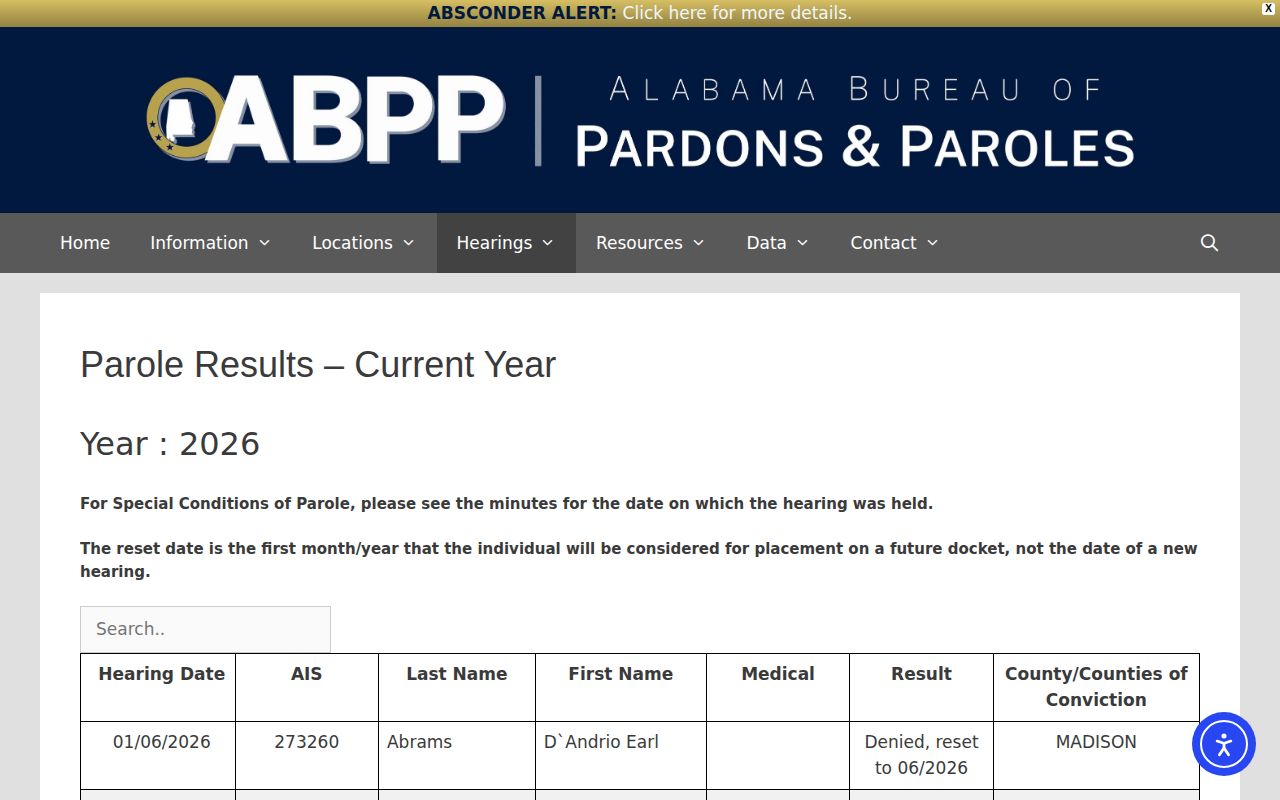
The results page should be read with ADOC and court fields, because a hearing result alone does not show every local jail or sentence-credit detail.
DeKalb Violations and Absconders
Supervision conditions are set by the order and agency record. Public pages can show the existence of parole status, hearing history, results, or absconder information, but they do not replace the supervising agency's record. ADOC defines parole status as showing whether a person is currently on parole, has been declared delinquent, or had parole revoked.
ABPP maintains an absconder-alert resource. An absconder alert is not the same as a new conviction or a new jail release. It is a supervision status that should be confirmed with ABPP, ADOC, or the relevant court record. If a DeKalb released person also has a new jail booking, the sheriff current roster or release feed may show a separate local custody event.
Mandatory Release Supervision
Mandatory release is separate from discretionary parole. ABPP's FAQ says Ala. Code Section 15-22-26.2 creates an automated release mechanism for eligible inmates with offenses committed on or after January 30, 2016, while excluding people convicted of a child sex offense and people serving life sentences. ADOC determines the mandatory release date and works with ABPP to prepare supervision.
This matters in DeKalb because a person sentenced from the county into ADOC may later return to the area under ABPP supervision. The local Fort Payne DRC Lite gives a DeKalb-specific reporting context, but the release-date and eligibility record still starts with ADOC and ABPP.
DeKalb Supervision Discharge
Supervision ends through discharge, revocation, sentence expiration, or a court or agency order. For a state-prison parole case, ADOC and ABPP records are the main path. For probation, the DeKalb Circuit Clerk is the place to verify court orders, sentence completion, or changes to probation terms. For a county jail release with no supervision, the sheriff release record and court disposition may be enough.
A complete DeKalb release check should keep three records apart: the jail release date, the court disposition, and any post-release supervision status. The home page explains the broader DeKalb County released inmates search path when the custody type is still uncertain.
Note: Alabama VNS and VINELink can help with custody-change notices, but agency records still control supervision terms and discharge.
DeKalb Probation Court Records
Probation questions often belong with the court record first. The DeKalb Circuit Clerk is the official record keeper for District and Circuit Court proceedings, and the research found criminal division contacts through the clerk site. A probation order, split sentence, revocation order, failure-to-appear issue, or sentence-completion entry may be in the case file even when the jail roster only shows the release from custody.
Alacourt ACCESS can help locate trial-court records, but the DeKalb docket search warns that some cases may not appear on the electronic docket. If a supervision question depends on a local court order, a no-match online should be followed by the clerk's office rather than treated as a final answer.
For DeKalb criminal cases, the research identified separate circuit criminal and district criminal clerk contacts under the same main courthouse phone. That supports a practical split: use ABPP for state parole supervision, but use the court clerk when the question is probation terms, certified copies, sentence changes, or whether a local case produced the supervision order.