
DeKalb Projected vs Actual Release
A projected release date is a scheduled or computed date. It is not the same as the actual release entry that appears after a person leaves custody. For Alabama state prisoners, ADOC's public terminology is "Minimum Release Date," which ADOC defines as the earliest scheduled date an inmate can be released to probation or end of sentence. For a DeKalb county jail detainee, the sheriff's release feed is retrospective, so it confirms a recent release after the event rather than predicting one.
Actual release depends on final processing. A state-prison date can change before it arrives. A county jail release can be delayed by a hold, court order, paperwork, transport, or another agency pickup. That is why date lookup should be paired with the custody source and the court record.
Find DeKalb Release Date Records
The date source changes by sentence type. A person serving less than one year in the DeKalb County Detention Center is handled through jail records and the sentencing court. A person awaiting transfer to ADOC may show a county release when moved, but the later prison release date comes from ADOC. A federal hold or immigration matter requires a federal channel.
- Start with the DeKalb sheriff current roster or 48-hour release feed to decide whether the person is still in county custody or has recently left.
- For a sentenced state prisoner, search ADOC by AIS number when known, or by first and last name.
- Open ADOC definitions while reading the result so minimum release date, jail credit, good time, and parole fields are not confused.
- For jail credit or sentence changes from a DeKalb case, check the DeKalb Circuit Clerk.
- For parole or mandatory release processing, check ABPP pages and supervision information.
- For release alerts, use VINE Inmate Check after confirming the person is in a covered system.
ADOC Minimum Release Date
ADOC is the key source once a DeKalb case becomes a state-prison sentence. ADOC's inmate search accepts AIS number, first name, and last name. The AIS number is the unique six-digit inmate number and is the fastest way to find the right record. When AIS is entered, ADOC says it takes precedence over the name fields.
| Field | Why it matters for a DeKalb release date |
|---|---|
| Minimum Release Date | ADOC's earliest scheduled date for release to probation or end of sentence. |
| Good Time Received | Credit awarded under Alabama correctional incentive rules. |
| Good Time Revoked | Credit removed as a disciplinary action. |
| Jail Credit | County jail time prepared by the sentencing county circuit clerk. |
| Parole Consideration Date | Tentative date set by the Parole Board for possible review. |
| Parole Status | Shows parole, delinquent, or revoked status when applicable. |
The captured ADOC definitions source below comes from ADOC's public definitions page.
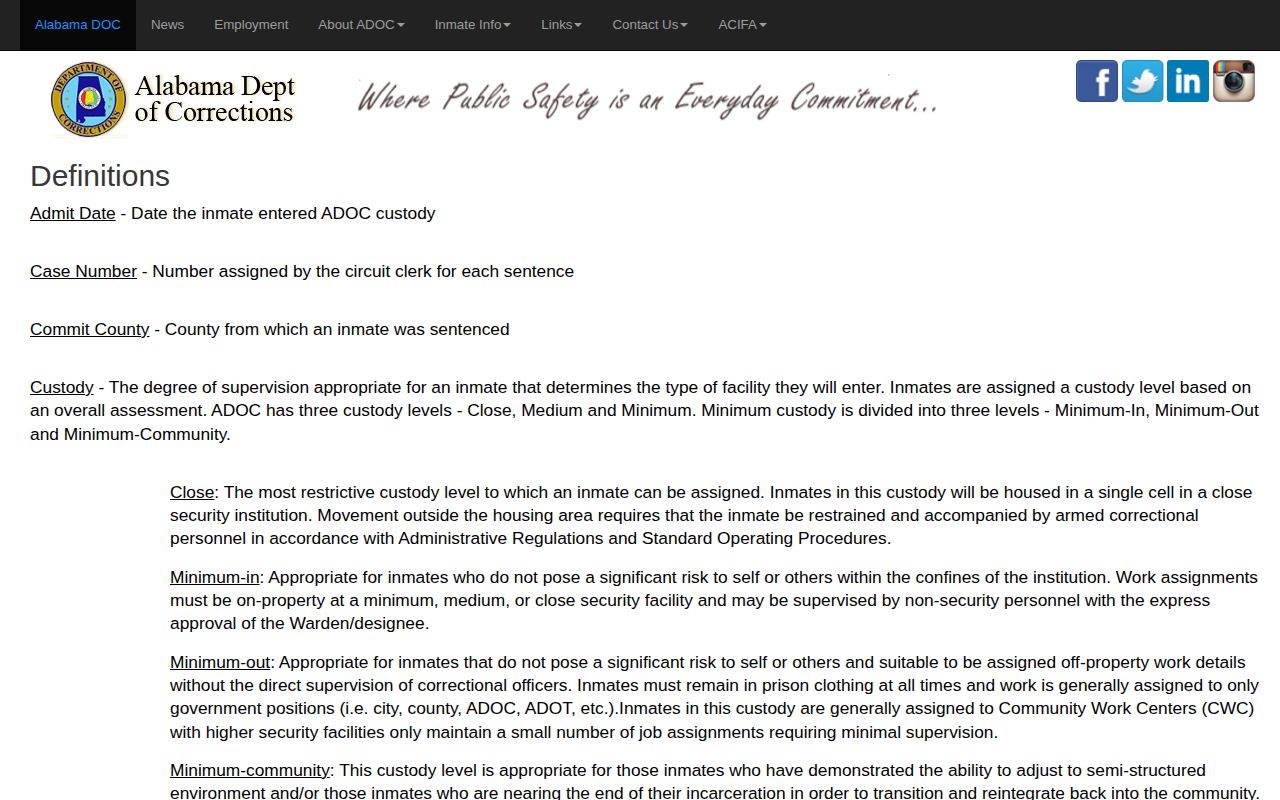
Those definitions are more reliable than trying to compute a release date from sentence length alone.
Alabama Good-Time Rules
Alabama correctional incentive time is governed by Ala. Code Section 14-9-41. The statute sets the good-time framework and includes exclusions. A prisoner may be ineligible if convicted of a Class A felony, a crime causing death by deadly weapon, a child sex offense as defined by the statute, or if sentenced to life, death, or more than 15 years. The exact record should be checked in ADOC.
Education incentive time is separate. Ala. Code Section 14-9-64 caps education incentive time at 12 months during any term and says the deduction is in addition to other available sentence deductions. That does not make release dates simple to calculate. It shows why a public ADOC field is better than a hand calculation.
The research did not find an official Alabama source supporting a universal "serve 85 percent" rule for every prisoner. Some offense classes, parole rules, good-time exclusions, and sentence categories can require long service, but the page should not state a blanket percentage. ADOC's minimum release date and ABPP's parole source are the safer official paths.
Why DeKalb Release Dates Change
ADOC says the minimum release date can change if the inmate receives disciplinaries that take away good time, if the circuit clerk sends new cases, or if the clerk changes the current sentence. That ties a DeKalb prison release date back to the DeKalb court record when the sentence, jail credit, or case status changes later.
| Factor | How it can change the date | Where to check |
|---|---|---|
| Good-time loss | Discipline can remove credit and move the date later. | ADOC fields and records. |
| New case | A new sentence or hold can alter custody status. | DeKalb Circuit Clerk and ADOC. |
| Sentence correction | Court updates can change term, jail credit, or calculation. | Circuit Clerk and ADOC. |
| Parole grant | ABPP must verify home plan and coordinate release. | ABPP and ADOC. |
| Federal or agency hold | Local release may become transfer, not community release. | Jail, BOP, ICE, or agency contact. |
DeKalb Jail Release Timing
The DeKalb jail page says the detention center holds people awaiting trial or transfer to ADOC and people sentenced to less than one year. For that local group, the sheriff's public release list shows a release date and time only after release occurs. It does not publish a projected-date calculator.
For a county jail sentence, check the sentencing order, jail credit, bond order, and any hold. The DeKalb Circuit Clerk is the court record source. The jail can confirm a booking or release record, but the final court sentence explains why the release happened or why it did not happen yet.
Note: If the person was transferred from the DeKalb jail to ADOC, the county release entry is not the final prison release date.
Parole and Mandatory Release Dates
Parole eligibility is not a release date. ADOC defines "Parole Consideration Date" as the tentative date set by the Parole Board. ABPP says eligibility is calculated under Ala. Code Section 15-22-28(e), and that sentence, crime, jail credit, ability to earn good time, time served, and court orders can affect eligibility.
ABPP also describes mandatory release supervision under Ala. Code Section 15-22-26.2 for eligible offenses committed on or after January 30, 2016, with exclusions. ADOC determines mandatory release and coordinates with ABPP. For DeKalb readers, that means a state-prison release date may lead to Fort Payne area supervision rather than a complete end of contact.
The ABPP FAQ source is shown in the captured image from ABPP parole FAQs.
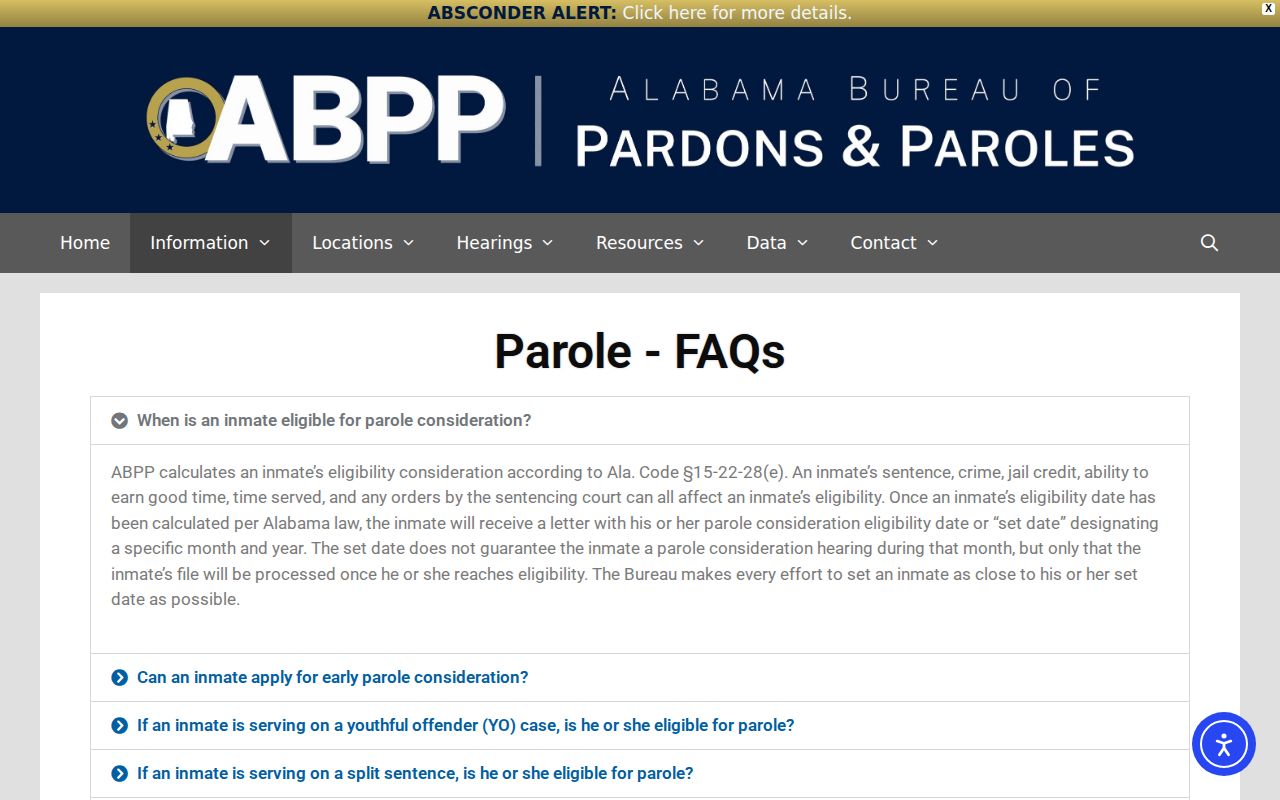
Use ABPP for parole-processing questions after ADOC confirms the state-prison sentence path.
Confirm DeKalb Release Dates
A release date should be confirmed close to the event because custody status can change. VINELink Alabama can send custody notifications for covered records, and Alabama VNS covers convicted Alabama offenders sentenced to prison. The VNS county-vs-state warning matters: pretrial county cases should be directed to the sheriff where the case occurred.
For the broad search path, use the DeKalb County released inmates hub at the home page. For a specific alert setup, use the VINE page. For a jail release record, call the DeKalb jail. For sentence computation, use ADOC and court records together.
DeKalb Jail Credit Checks
Jail credit is one of the easiest release-date details to misunderstand. ADOC defines jail credit as time spent in county jail before sentencing and says the circuit clerk of the sentencing county prepares that time. For a DeKalb sentence, the DeKalb Circuit Clerk can therefore matter even after the person has moved to ADOC custody. If jail credit is missing, changed, or disputed in the sentence paperwork, the minimum release date may also change after ADOC receives updated court information.
Use the jail record to identify the custody period, then use the court record to verify how that time was credited in the sentence. ADOC applies the sentence and credit fields in the state record, but it does not replace the sentencing county's court paperwork. That is why a DeKalb release date lookup should keep jail dates, court sentencing entries, and ADOC computation fields together.
The county jail release feed is helpful for the end of a local booking, but it does not show every sentence-computation detail. A person could have several bookings, a sentence modification, a new case, or an amended order that changes the state calculation. If the public ADOC date changes, compare the ADOC record with DeKalb court updates before assuming the old date was an error.